Field data
We metered the oxygen flow at a large veterinary hospital every ten seconds for four weeks. Here is what that oxygen would have cost in delivered cylinders — including the part that never appears on the invoice.
Delivered oxygen for this practice would run somewhere between $25,000 and $131,000 a year, depending entirely on what their gas supplier charges. Generating it on site costs about $2,400 a year in electricity and cooling. Put in comparable terms: oxygen generated on the premises cost this hospital about $0.27 per 1,000 liters, against $2.25 to $11.73 per 1,000 liters for delivered H cylinders, depending on the supply contract. Even measured against the lowest institutional gas pricing we could document anywhere in the country — pricing no private practice will ever be offered — the system pays for itself in about thirteen months. At the prices a practice actually pays, it is closer to three to five.
How much oxygen does a veterinary hospital actually use?
Ask a practice manager how much oxygen the hospital uses and you will usually get an answer in deliveries. Two a week. Ten per month. The invoice total. That is not usage — it is procurement. It tells you what you bought, not what you needed, and it cannot tell you whether the next busy day will outrun your supply.
So we put a flow meter on the line and logged it every ten seconds for a month, alongside the pressure in the storage tank.
In this case, the practice is a multi-doctor emergency and specialty hospital. Oxygen feeds six anesthesia machines and an ICU cabinet with four chambers, each about three feet on a side, run from a central controller that maintains a set oxygen percentage in each chamber independently. Four ICU cages is large for a veterinary practice — many clinics have none, quite a few have one or two, so four puts this hospital near the top of the range.
When you’re using delivered cylinders, you can count tanks to get a rough handle on a monthly total. But that monthly total won’t tell you what size generator the practice actually needs. The graphs shown below compare two metrics for an HVO system: tank pressure and liters-per-minute outbound to the hospital.

Demand ranged from under 5 liters per minute to 113 LPM sustained for ten minutes. Average draw was 21.6 LPM. If you sized a system on the average you would be wrong; if you sized it on the peak you would buy roughly five times more machine than the hospital needs. The key is to determine the maximum draw of each oxygen-consuming device, and how many are likely to be in use simultaneously. You can exceed the production rate of the oxygen generator for a short time, but not indefinitely.
What 933,000 liters looks like in H cylinders
A standard H cylinder holds about 7,200 liters. At 933,000 liters a month, this hospital would go through about 130 of them — roughly four and a half every day.
Picture that before you price it: a delivery every three days at minimum, a storage room dedicated to a battery of chained high-pressure tanks (each one about 150 pounds full), and someone walking a hand truck down a hallway several times a day — a hallway that also has patients in it.
You do not rent 130 cylinders a month. You rent the whole standing inventory, though you’ll only have a small number of tanks connected to your central lines at a time.
To burn 130 cylinders a month on two deliveries a week, you need roughly 38 on site at any given moment: the ones in use, the full ones staged behind them, the empties waiting for pickup, and enough slack that a missed delivery is not an emergency. Drop to one delivery a week and you need closer to 68. You pay rent on all of them.
What do oxygen cylinders cost a veterinary practice?
Gas suppliers quote privately, and pricing swings enormously with volume and region, so we built the range from published figures rather than guessing at one number.
| Scenario | Gas | Rental | Delivery | Hazmat | Total |
|---|---|---|---|---|---|
| Large institutional contract | $25,160 | — | — | — | $25,160 |
| Mid-market account | $69,975 | $3,648 | $2,610 | $1,566 | $77,799 |
| Small account, retail rates | $116,625 | $6,384 | $5,220 | $3,132 | $131,361 |
Assumes a 38-cylinder standing fleet and roughly two deliveries per week.
That $25,160 low-end figure is real, not hypothetical, and it is worth understanding what it represents. The University of Florida’s contract with Airgas prices a size-300 medical oxygen cylinder at $16.18 delivered — with no delivery charge and no hazmat fee at all. That is the buying power of a research university with tens of thousands of cylinder transactions a year. It is the best documented price in the country, and it is not available to a veterinary hospital.
What a practice actually sees looks more like the bottom two rows: a per-cylinder gas charge several times higher, monthly rent on every cylinder in the building, a delivery charge per stop, and a hazmat fee on top of that because compressed oxygen is a regulated material and somebody has to be licensed to drive it to you.
The labor cost of managing oxygen cylinders
Every one of those 130 cylinders has to be handled by a person, and that person is almost always a credentialed technician.
| Task | Frequency | Each | Hours |
|---|---|---|---|
| Cylinder changeouts | 130× | 8 min | 17.3 |
| Receiving and staging deliveries | 9× | 30 min | 4.3 |
| Moving empties for pickup | 9× | 20 min | 2.9 |
| Ordering, inventory, invoice reconciliation | 4× | 30 min | 2.0 |
| Total | 26.6 |
Twenty-seven hours a month. At the national average veterinary technician wage of $23 an hour, loaded to about $30 with payroll taxes and benefits, that is roughly $9,500 a year.
But the dollar figure misses the real cost. That is twenty-seven hours a month of licensed clinical staff moving steel instead of touching patients — time that could go to anesthesia monitoring, client communication, or just going home on time, in a field that’s already short-staffed.
What does a centralized oxygen generator cost to run?
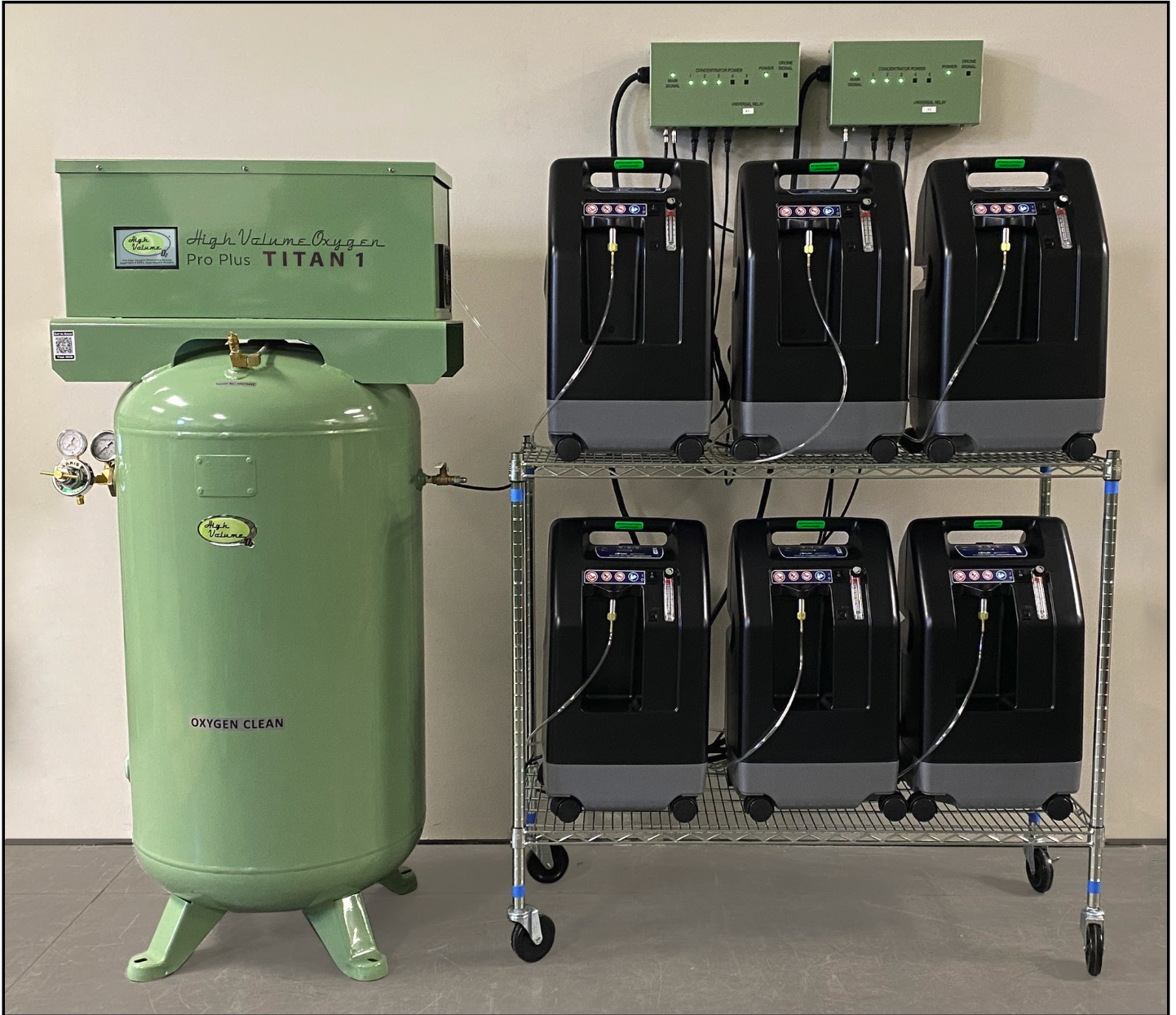
A centralized oxygen generator — one system piped to every point of use, not a portable concentrator at the bedside — trades a recurring bill for a capital purchase and an electricity meter. These systems run a bank of oxygen concentrators feeding a pressurized storage tank, and the hospital draws from the tank rather than from a cylinder. For an oxygen generator sized to this hospital — 60 LPM with an 80-gallon tank — here is the whole picture.
| Oxygen generator, MSRP | $33,390 |
| Shipping | $1,500 – 2,000 |
| Electricity — 4.2 kW draw, running about half the time | $2,160 / yr |
| Added cooling load — 3,600 BTU/hr | $224 / yr |
| Maintenance, 2% of purchase price | $668 / yr |
| Annual operating cost | $3,051 / yr |
Electricity at $0.125/kWh. Maintenance is covered under the three-year warranty, concentrators included, so real years one through three run about $2,384.
That works out to 27 cents per 1,000 liters of oxygen generated, against $2.25 per 1,000 liters at the best institutional cylinder pricing in the country and $11.73 at retail. Put another way, a single kilowatt-hour of electricity makes roughly 650 liters of oxygen.
Two prerequisites are worth checking before anyone gets excited about the arithmetic. The system needs a room between 50 and 80°F with six to eight air changes an hour — a mechanical space, not a closet. And because this is a centralized solution, the hospital needs piped medical gas lines running to each point of use. A practice that currently wheels a cylinder to whichever room needs it is looking at a plumbing project, not just an equipment purchase.
What each option actually costs you
Both options come with strings attached — they’re just different strings, due at different times.
To buy an oxygen generator requires decisions to be made about the clinic’s O2 needs: how much capacity, sized against what demand. Get that right and generation sits comfortably above your peak, with room to add capacity later if the practice grows. At HVO, we can help you get this number right, as we’ve been sizing systems since 2011.
Delivered cylinders provide a fixed amount of oxygen that will run out at some point. You’ll contract for some number that will arrive weekly or monthly. There are deliveries to receive, floor space to give up, and in this clinic’s scenario, roughly 130 units at about 150 pounds each — every one of them secured, moved, connected and returned by hand. That workload grows with every additional liter. There’s no volume at which cylinders get easier.
Every option has limits. The real question is which costs you’d rather carry, and for how long.
A caveat about oxygen costs
The cylinder costs in this case are modeled, not invoiced
That’s because the clinic in this example had already purchased an HVO system by the time we started measuring their usage. They are a new hospital, so there was no history of delivered cylinder costs. The cost figures we used are built from published university contract pricing, published rental rates, and published hazmat fees — not from one hospital’s bill. Real pricing may land anywhere in that range, so your own invoices are the only numbers that matter for your practice.
Common questions about veterinary oxygen costs
How many liters of oxygen are in an H cylinder?
A standard H cylinder (also called a size 300 or K cylinder depending on the supplier) holds approximately 7,200 liters of oxygen at 2,200 psi. That is the figure used throughout this article to convert measured usage into cylinder counts.
How much oxygen does a veterinary hospital use per month?
The hospital in this study used 933,000 liters per month, an average draw of 21.6 liters per minute with peaks reaching 113 LPM. This is a large consumer — a multi-doctor emergency and specialty practice running six anesthesia machines and a four-chamber ICU. A general practice with one or two anesthesia machines and no ICU would use a small fraction of this.
How much does medical oxygen cost per liter?
Delivered in H cylinders, oxygen cost between $2.25 and $11.73 per 1,000 liters in our modeling, depending on whether the buyer holds a large institutional contract or pays small-account retail rates. Generated on site with an oxygen generator, the same 1,000 liters cost about $0.27 — roughly one kilowatt-hour of electricity makes 650 liters.
Is an oxygen generator cheaper than delivered oxygen cylinders?
Above a certain volume, substantially. The comparison turns on how much oxygen you actually use: a generator’s cost is mostly fixed, while cylinder cost scales with every liter. At this hospital’s 933,000 liters a month, centralized generation was roughly eight to forty times cheaper per liter. At a fraction of that volume the gap narrows and cylinders can be the better answer, which is why measuring usage comes before any purchase decision.
How long does an oxygen generator take to pay for itself?
At this hospital’s usage, between three and thirteen months. The thirteen-month figure assumes the buyer already pays the lowest documented institutional cylinder pricing in the country; three months reflects retail rates. Over five years the difference totals $125,000 to $656,000.
What does a veterinary oxygen generator cost?
A 60 LPM system with an 80-gallon storage tank — the configuration sized to this hospital — has an MSRP of $33,390, plus roughly $1,500 to $2,000 shipping. Operating cost runs about $3,051 a year including electricity, added cooling load, and maintenance budgeted at 2% of purchase price.
What does installing a centralized oxygen generator require?
Three things. Piped medical gas lines to each point of use, since a generator is a centralized source rather than a portable cylinder. A mechanical room held between 50 and 80°F with six to eight air changes per hour. And electrical capacity for a 4.2 kW draw. A practice without existing medical gas piping is looking at a plumbing project alongside the equipment purchase.
Is oxygen from a generator the same purity as cylinder oxygen?
Not identical. Concentrator-based systems typically deliver oxygen in the 93 to 95% range, measured continuously at this installation, while delivered medical cylinders are approximately 99%. The balance is argon and nitrogen rather than any contaminant. Oxygen at 93% is a recognized medical concentration with its own USP monograph, and is widely used clinically — but the difference is real and worth discussing for your specific applications.
Five-year cost: cylinders vs. centralized oxygen generation
Everything above is one month of data. Multiply it across the life of the equipment and this stops being a line item — it becomes a capital decision.

Five-year totals. Cylinder figures include the labor burden; generation includes purchase, shipping, power, cooling and maintenance.
Start by measuring your oxygen usage
The hospital in this data had been running for years on an educated guess. When the numbers finally arrived, the surprise was not the total — it was that the load never let up. Demand overnight ran within four percent of demand at midday, which means there is no quiet hour to plan around, and no version of this hospital where a smaller number would have been the right answer.
None of that was visible from an invoice. It took a meter.
If you want to know what your hospital actually uses, we will meter it and tell you — whatever the answer turns out to recommend. Either way, you’ll have your own numbers instead of a guess.


